File 01 / Mid-fold flickerIn review
- AIn review
- BPending
- CPending
Record A / Source pair
Read the source pair.
| Model position | Contact record |
|---|
Finding / Localized fault
A design study in diagnostics
An illustrated troubleshooting handbook for repair trainees. Read three simulated repair records for a folding desk lamp. Each contains one fault. Use your own notebook to leave the next trainee a finding they can check.
Proposed prototype · Simulated readings · Fictional lamp
Enter the bench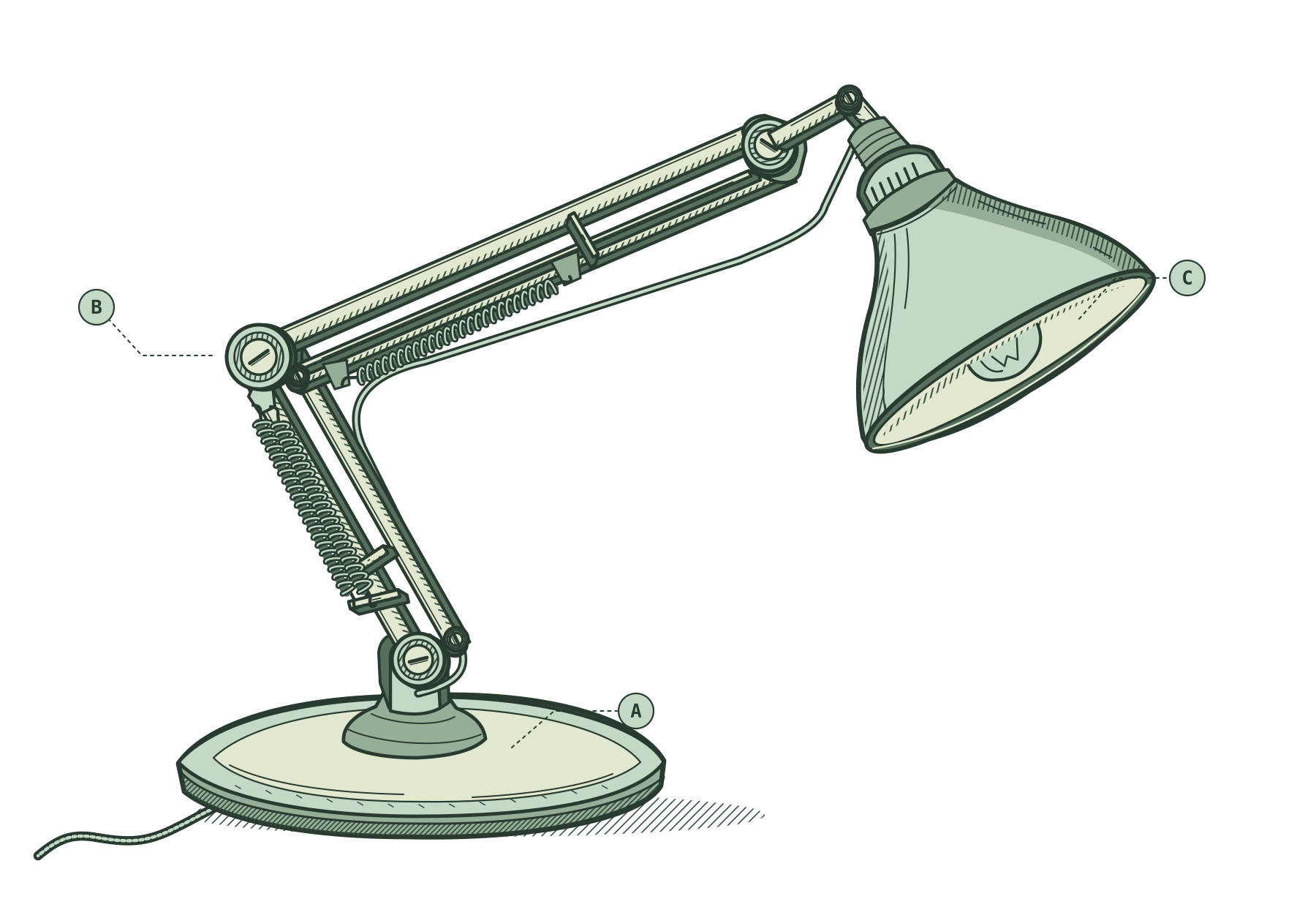
Interactive fault study
Choose a file and read each table from top to bottom. Does the contact stay continuous through all three positions?
Picture a repair class at handover. The outgoing trainee has left a sketch and the words “lamp flickers.” The next reader needs to know which part moved and where the connection failed. Every movement and reading in this exercise comes from the simulation.
Record A / Source pair
| Model position | Contact record |
|---|
Finding / Localized fault
Reference sheet
Read from the base toward the shade. A continuous segment moves the investigation forward. An open segment identifies the break.
The two contacts in the base connect the removable cell tray to the lamp circuit.
Open → tray contactA flexible conductor follows the linked arms. Compare the halfway fold with the two upright readings in File 01.
Open → pivot leadThe final pair of contacts sits at the lamp head, between the arm lead and the emitter.
Open → socket contactAnnotated casebook
Use these entries to check a finished case or read them as a paper exercise. Each pairs a line you could leave in the handover book with the observations that earn it.
File 02 · Tray position
“The source pair loses contact with the tray shifted left. Both centered readings are continuous.”
This file ends at A. The three positions localize the gap to the tray contact, the first link in the model. A reader can verify the finding from that single table. Leave the pivot and socket out of the entry because this case supplies no readings for them.
File 01 · Arm position
“The pivot lead opens halfway through the fold and closes when the arm returns upright.”
The source pair stays continuous in all three rows. At the pivot, the upright readings agree with each other, but the halfway reading is open. Someone reading just the first and last rows would miss the fault. Keep the middle position in the handover note.
File 03 · Shade position
“The socket connects with the shade dipped. It is open at both level positions.”
The source pair and pivot lead stay continuous throughout. The socket record reads open, continuous, open. Dipping the shade restores contact in this case. Reversing that detail would give the next reader the wrong position for the dropout.
About the model
The Contact Handbook is a proposed educational software prototype for Intellicore Systems. The DL–01 is a fictional teaching object drawn for this edition. Its base, arm and shade give the reader three places to look on the assembly plate.
Each file changes one contact in a series path. “Continuous” means the model recorded a connection at that position. “Open” means it recorded a break. Position changes are paired with a return to the starting position so you can see whether the first reading repeats.
The bench compares your choice with the three stored readings for that segment. A missed observation leaves the table in view with a prompt to read it again. A completed file gives you a named fault and a trail of segments checked. Replay the file to check each line of the trail against its table.
Handover sheet · DL–01
A good handover names the segment, the position and the reading that proves it. Replay a file, then copy these three lines into your own notebook.
About this edition. The Contact Handbook is a proposed educational prototype for Intellicore Systems. This edition has no verified public business contact. The casebook and bench are available here for individual practice or a classroom handover.
Intellicore SystemsTunmise Wemimo, Founder